


Delivered to your inbox every Monday, Last Week in AI Policy is a rundown of the previous week’s happenings in AI governance in America. News, articles, opinion pieces, and more, to bring you up to speed for the week ahead.
Policy
The White House released its much anticipated AI Action Plan on Wednesday, outlining its strategy to secure long-term U.S. dominance in artificial intelligence.
Authored by Office of Science and Technology Policy Director Michael Kratsios, AI and Crypto Czar David Sachs and Secretary Marco Rubio, the document is structured around three pillars:
Accelerate AI Innovation
Build American AI Infrastructure
Lead in International AI Diplomacy and Security
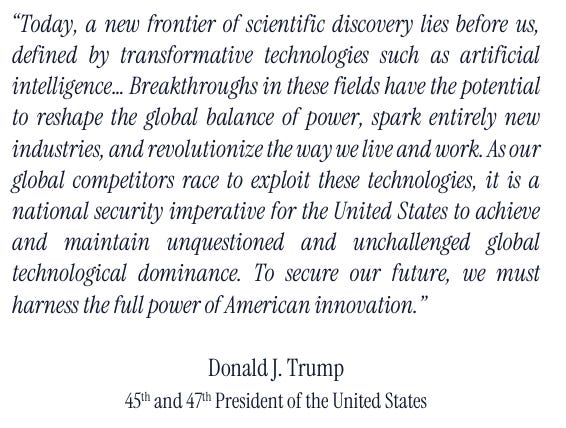
It has been released following months of research and feedback from industry and members of the public.
On the same day, President Trump published three Executive Orders focusing on preventing “woke AI” in the federal government, accelerating the expansion of data center infrastructure and promoting the exporting of American AI tech.
Drawing directly on the Action Plan, the three orders represent a kickstart for the administration’s new aspirations to enforce ideological neutrality in AI systems, remove Biden-era red tape, and shape the global landscape.
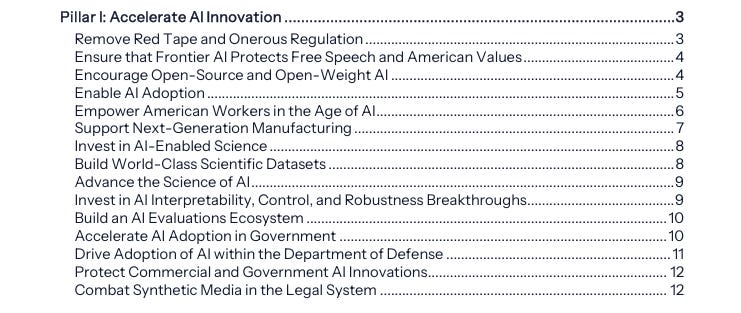
Pillar I addresses the ways in which the federal government will enable private-sector innovation on AI.
Although there is an underlying focus on more conventional strategies such as removing red tape, the plan also introduces novel ideas not yet tested at the federal level, such as regulatory sandboxes, hackathons, and testbeds for key sectors, and a shift toward open-source and open-weight AI development.
The plan hints at the infamous and now-buried moratorium on state-level AI regulation.
It does add that the Federal government “should not interfere with states’ rights to pass prudent laws that are not unduly restrictive to innovation,” however this mirrors the caveat added to the final wording of the provision that was struck down 99-1 just a few weeks ago.

Another notable feature of the plan is its stated intent to “ensure that frontier AI protects free speech and American values.”
One way the administration intends to do this is by ensuring that “AI procured by the Federal government objectively reflects truth rather than social engineering agendas.”
As ChinaTalks’s Jordan Schneider points out, this seems contradictory. Although, there are reports that the administration will apply this principle with some flexibility.

Pillar II focuses on building the physical and technical foundations needed to support national AI ambitions.
A core emphasis is placed on overhauling energy, compute, and semiconductor infrastructure, with the administration calling for:
Streamlined permitting processes
Expanded federal land use
A modernized power grid to meet AI-related demand
It also prioritizes restoring domestic semiconductor manufacturing, securing high-assurance data centers for military use, and training a skilled workforce to support AI infrastructure buildout.

Pillar III outlines the administration’s approach to international AI diplomacy and security, aiming to solidify U.S. leadership on the global stage.
The plan commits to exporting the full American AI stack to allies, while countering authoritarian influence in multilateral bodies and international governance frameworks.
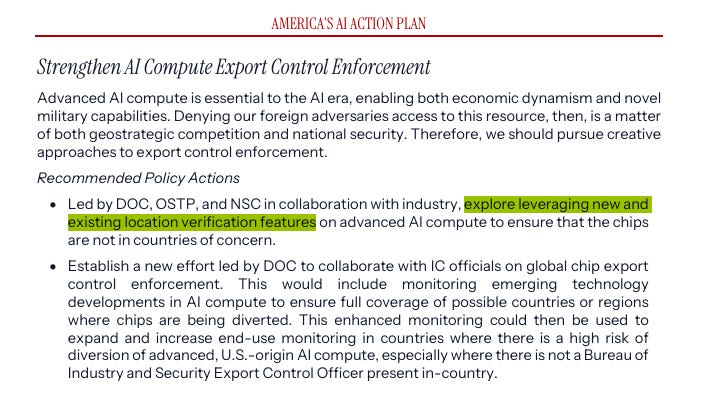
It proposes stronger enforcement of export controls, including new mechanisms to prevent advanced chips from reaching adversaries through the use of location verification technology and end-use monitoring—echoing provisions in the bipartisan Chip Security Act, introduced to the House in May.
Other measures include plugging loopholes in semiconductor manufacturing controls, aligning protection rules with allies, and conditioning foreign aid and development financing on AI safety standards.
Just days later, China released an AI action plan of its own
Chinese Premier Li Qiang announced their proposal to establish a global AI cooperation organization.
"We should strengthen coordination to form a global AI governance framework that has broad consensus as soon as possible,” he said.
Their plan leans heavily toward international cooperation on AI, including proposals for joint research and a global ethics body.
Li also indicated that China would be willing to share its technology with developing countries.
The Department of Energy has selected four sites—Idaho National Laboratory, Oak Ridge Reservation, Paducah Gaseous Diffusion Plant, and Savannah River Site—for the development of AI data centers and energy infrastructure in partnership with the private sector.
The announcement advances President Trump’s Executive Order on Accelerating Federal Permitting of Data Center Infrastructure, aligning with broader goals to reduce energy costs, enhance national security, and position the U.S. at the forefront of the global AI race.
The selected locations are strategically suited to host both high-density compute and advanced energy generation, forming the backbone of what Energy Secretary Chris Wright described as “the next Manhattan Project.”
“By leveraging DOE land assets for the deployment of AI and energy infrastructure, we are taking a bold step to accelerate the next Manhattan Project—ensuring U.S. AI and energy leadership,” said Secretary Wright.
DOE expects to release site-specific solicitations in the coming months, with partner selection anticipated by year’s end. Additional federal sites are under evaluation for future project phases.
Press Clips
AI Copyright Cases Will Shape the Future (Maxwell Tabarrok, Maximum Progress) ✍
AI Can’t Replace Free Markets (Marian L. Tupy and Peter Boettke, Wall Street Journal) ✍
Why China isn’t about to leap ahead of the West on compute (Veronika Blablová and Robi Rahman, Epoch AI) ✍
AI Grand Strategy & The Rest of the World (Anton Leicht, Threading the Needle) ✍
Why is Hugging Face hosting tools to make deepfake porn of teenage celebrities? (Shakeel Hashim, Transformer) ✍
AI and the New Economy (Special Competitive Studies Project) ✍
Anthropic Faces Potentially “Business-Ending” Copyright Lawsuit (Garrison Lovely) ✍