

Delivered to your inbox every Monday, Press Clips is a rundown of the previous week’s happenings in politics and technology in America. News, articles, opinion pieces, and more, to bring you up to speed for the week ahead.
Policy
Sen. Ted Cruz (R-TX) introduces the SANDBOX Act
On September 10, Sen. Ted Cruz (R-TX), chair of the Senate Commerce Committee, introduced the SANDBOX Act (Strengthening AI Normalization and Diffusion By Oversight and eXperimentation).
The bill would allow AI companies to seek waivers from federal regulations for up to ten years, enabling what Cruz called a “regulatory sandbox” to “turbocharge economic activity, cut through bureaucratic red tape, and empower American AI developers”
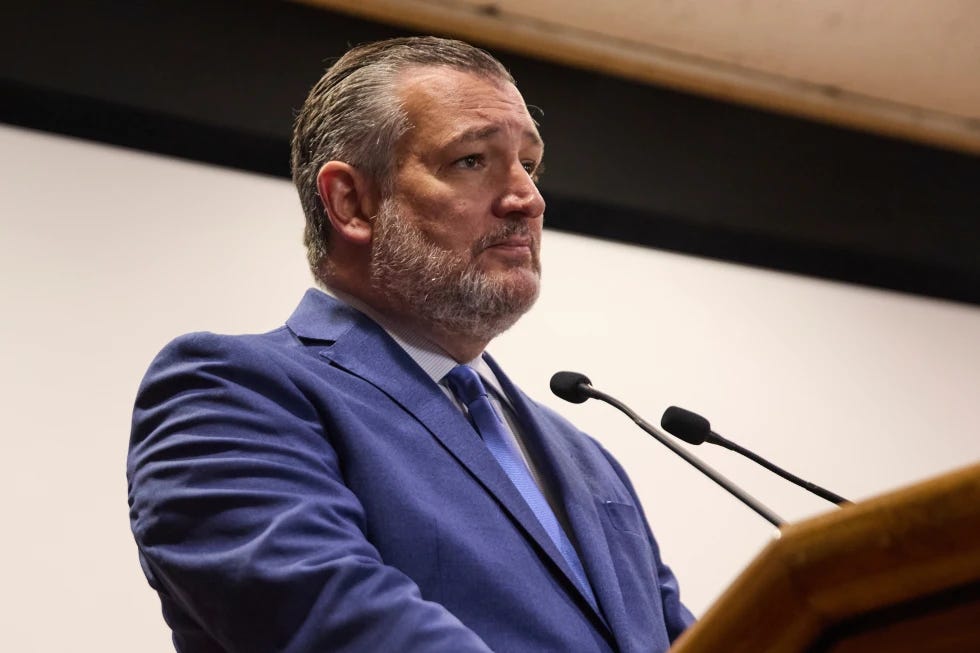
Cruz linked the bill to President Trump’s AI Action Plan, warning that “America is in an AI race against China” and that failure to lead could mean AI defined by “regimes that use AI to control rather than to liberate”
The legislation sits within a five-pillar Cruz AI policy framework: unleashing innovation, protecting free speech, avoiding a patchwork of state regulation, preventing harmful uses of AI (e.g., scams, deepfakes), and defending human dignity and bioethical safeguards.
The bill empowers the Office of Science and Technology Policy (OSTP) to grant waivers for two-year periods, renewable up to a decade, and even override federal agency objections.
It also instructs OSTP to recommend to Congress which existing regulations could be repealed based on sandbox experience.
At the rollout hearing, Cruz emphasized: “A regulatory sandbox is not a free pass. People creating or using AI still have to follow the same laws as everyone else. Our laws are adapting to this new technology.”
The bill drew backing from the U.S. Chamber of Commerce, the Information Technology Council, and the Abundance Institute, which welcomed “a well-defined sandbox for innovators” while noting the need for careful limits to avoid “reckless behavior” like that of social media firms.
Consumer advocates and watchdog groups reacted sharply:
Public Citizen argued the bill “puts public safety on the chopping block in favor of corporate immunity,” treating “Americans as test subjects.”
Critics highlighted provisions allowing OSTP to overrule independent regulators.
Ars Technica warned this could open the door to “sweetheart deals” where firms curry favor with the Trump White House, undermining consumer protection.
The Alliance for Secure AI noted that Big Tech has “refused to remain transparent with the public about the risks of advanced AI,” warning that removing oversight now “raises many questions about who can enter the so-called ‘sandbox’ and why.”
See here for summary of the bill, a hearing, and the full text of the bill.
California rejects bill on AI decision making in hiring
California Assembly Bill 1018, which sought to regulate high-risk AI systems in areas like hiring, housing, health care, and finance, failed to advance before the legislative deadline and was postponed until 2026.
The bill would have required companies and agencies to notify people when AI was used in consequential decisions and granted individuals the right to appeal errors, echoing principles from the federal AI Bill of Rights.
Major tech companies, venture capital firms, health care providers, and the state judiciary opposed the measure, warning it could cost hundreds of millions annually and impose an “untested audit regime.”
Unions and consumer groups backed the bill, with advocates stressing that “poll after poll shows Americans want strong laws on AI.”
Assemblymember Rebecca Bauer-Kahan said the delay reflects a commitment to “getting this critical legislation right, not a retreat”
Press Clips
Three challenges facing compute-based AI policies (EpochAI) ✍
China's New AI Plan (ChinaTalk) ✍
Book Review: 'If Anyone Builds It, Everyone Dies: Why Superhuman AI Would Kill Us All' (Transformer) ✍
How to Write the AI Action Plan (Statecraft) 🔉
Albania appoints world’s first AI-made minister (POLITICO) ✍
Uneven geographic and enterprise AI adoption (Anthropic) 📊
AI, Jobs, and the Rest of the World (Anton Leicht) ✍
Do artificial intelligences have culture? (Unpredictable Patterns) ✍
The Cold Reality for Chinese AI Start-ups (ChinAI Newsletter) ✍
Hiring struggles are plaguing the EU AI Office (Transformer) ✍
On China's open source AI trajectory (Interconnects) ✍