

Delivered to your inbox every Monday, Press Clips is a rundown of the previous week’s happenings in politics and technology in America. News, articles, opinion pieces, and more, to bring you up to speed for the week ahead.

Top Story
China expands export controls on rare-earth minerals and related technology
China’s Commerce Ministry added five more rare-earth elements to its export control list, bringing the total to 12, citing the need to “safeguard national security.”
The measures extend to mining and refining technology, and introduce an export licensing system for products containing Chinese-origin rare-earth materials.
Defense organizations will not be granted licenses, while exports for semiconductor manufacturing will be reviewed individually.
Humanitarian uses, such as in disaster relief and public health, are exempt.
In response, President Donald Trump called the decision a “sinister and hostile move” and said the U.S. was preparing a “massive increase of tariffs on Chinese products.”
Trump added there now “seems to be no reason” to meet with President Xi Jinping, with whom he had been expected to hold talks in South Korea later this month.
Policy
Senate passes NDAA including GAIN AI Act on chip export controls
The Senate voted 77–20 to pass the Fiscal Year 2026 National Defense Authorization Act (NDAA), which includes the Guaranteeing Access and Innovation for National Artificial Intelligence Act of 2025 (GAIN AI Act).
The measure, introduced by Sen. Jim Banks (R-IN), requires major chip manufacturers to prioritize U.S.-based customers before exporting AI-tailored semiconductors abroad.
The amendment bars firms from selling to competing countries, offering preferential pricing overseas, or exporting chips while domestic orders remain unfulfilled.
Supporters, including Sen. Elizabeth Warren (D-MA) and the advocacy group Americans for Responsible Innovation, described the provision as a step to reduce domestic backlogs and promote U.S. technological leadership.
Nvidia has continued to oppose expanded export controls, maintaining research operations in Shanghai and warning against limits on global chip markets.
The NDAA now heads to conference negotiations with the House, which passed its version earlier in September.
President Trump signs executive order on using AI to combat pediatric cancer
President Donald Trump signed an executive order directing federal agencies to leverage artificial intelligence in pediatric cancer research and treatment.
The order builds on the Childhood Cancer Data Initiative (CCDI) and aligns with the Make America Healthy Again (MAHA) Commission, prioritizing the use of AI-enabled science to improve diagnostics, treatment, and clinical trial design.
The order tasks the MAHA Commission, the Department of Health and Human Services, and the Office of Science and Technology Policy with accelerating AI-driven solutions across cancer data ecosystems and research centers.
It calls for expanding federal and private investment, strengthening data-sharing infrastructure, and ensuring patient control over health information.
The administration said the policy aims to “translate data and AI capabilities into improved care” and ultimately “unlock cures for pediatric cancer.”
Bernie Sanders releases report warning AI could displace nearly 100 million U.S. jobs
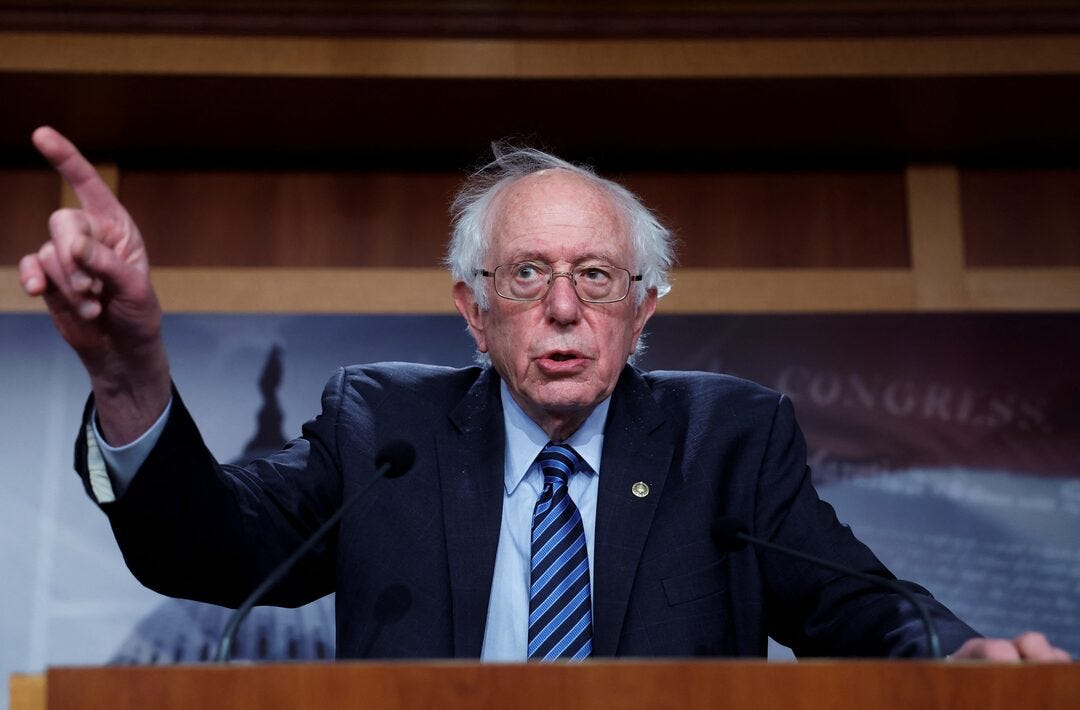
Sen. Bernie Sanders (I-VT) released a report warning that artificial intelligence and automation could eliminate up to 97 million American jobs over the next decade.
The report, The Big Tech Oligarchs’ War Against Workers, argues that major corporations and the Trump administration are using “artificial labor” to reduce wages, weaken unions, and consolidate corporate power.
The report cites companies including Amazon, Walmart, JPMorgan Chase, and Meta as examples of employers deploying AI systems to monitor, evaluate, or replace workers.
It urges Congress to adopt new safeguards, including a 32-hour workweek without loss of pay, a tax on corporate automation, and stronger collective bargaining rights for workers affected by AI-driven restructuring.
Sanders said the findings underscore the need for a national strategy to manage AI’s labor impacts, warning that without intervention, technological change will “further enrich billionaires while working people lose their jobs, their income, and their dignity.”
House committee report accuses U.S. firms of aiding China’s semiconductor ambitions
The House Select Committee on the Chinese Communist Party released a report titled Selling the Forges of the Future, alleging that U.S. semiconductor equipment manufacturers continue to sell advanced tools to Chinese firms tied to the People’s Liberation Army and state surveillance programs.
The report claims these sales have “fueled [China’s] plans for military and economic dominance and digital authoritarianism.”
The investigation found that Chinese chipmakers are purchasing tens of billions of dollars’ worth of U.S. equipment annually, including from companies providing maintenance services to restricted entities.
The committee urged the Department of Commerce to tighten export licensing, expand end-use monitoring, and close loopholes that allow advanced manufacturing tools to reach Chinese fabs.
Committee Chair Rep. John Moolenaar (R-MI) said the findings show that U.S. toolmakers are “selling the forges of future weapons and surveillance tools” to Chinese state-backed firms, and called for stronger coordination across agencies overseeing technology exports.
Press Clips
An intense battle over the RAISE Act is entering its final stretch (Transformer) ✍
Middle powers can gain AI influence without building the next ChatGPT (AI Policy Bulletin) ✍
The Future and Its Friends (Dean Ball) ✍
Emergency Pod: China’s Rare Earth Export Controls (ChinaTalk) 🔉
AI Hardware Net Assessment: Why Huawei Can’t Beat Nvidia (ChinaTalk) 🔉
Sinicising AI: Zheng Yongnian on Building China’s Own Knowledge Systems (Sinification) ✍
A Preemption Deal Worth Making (Anton Leicht) ✍
AI can now do math. But can it ask good questions? - Ken Ono (Epoch AI) 📽
Why frontier AI can’t solve this professor’s math problem (Epoch AI) 📽
Thoughts on The Curve (Nathan Lambert, Interconnects) ✍🔉
The Last Invention Podcast Series (Longview) 🔉
Right-Sized AI Infrastructure (Chipstrat) ✍
Designing role-playing games to help AI governance (AI Policy Perspectives) ✍