


Delivered to your inbox every Monday, Last Week in AI Policy is a rundown of the previous week’s happenings in AI policy and governance in America. News, articles, opinion pieces, and more, to bring you up to speed for the week ahead.

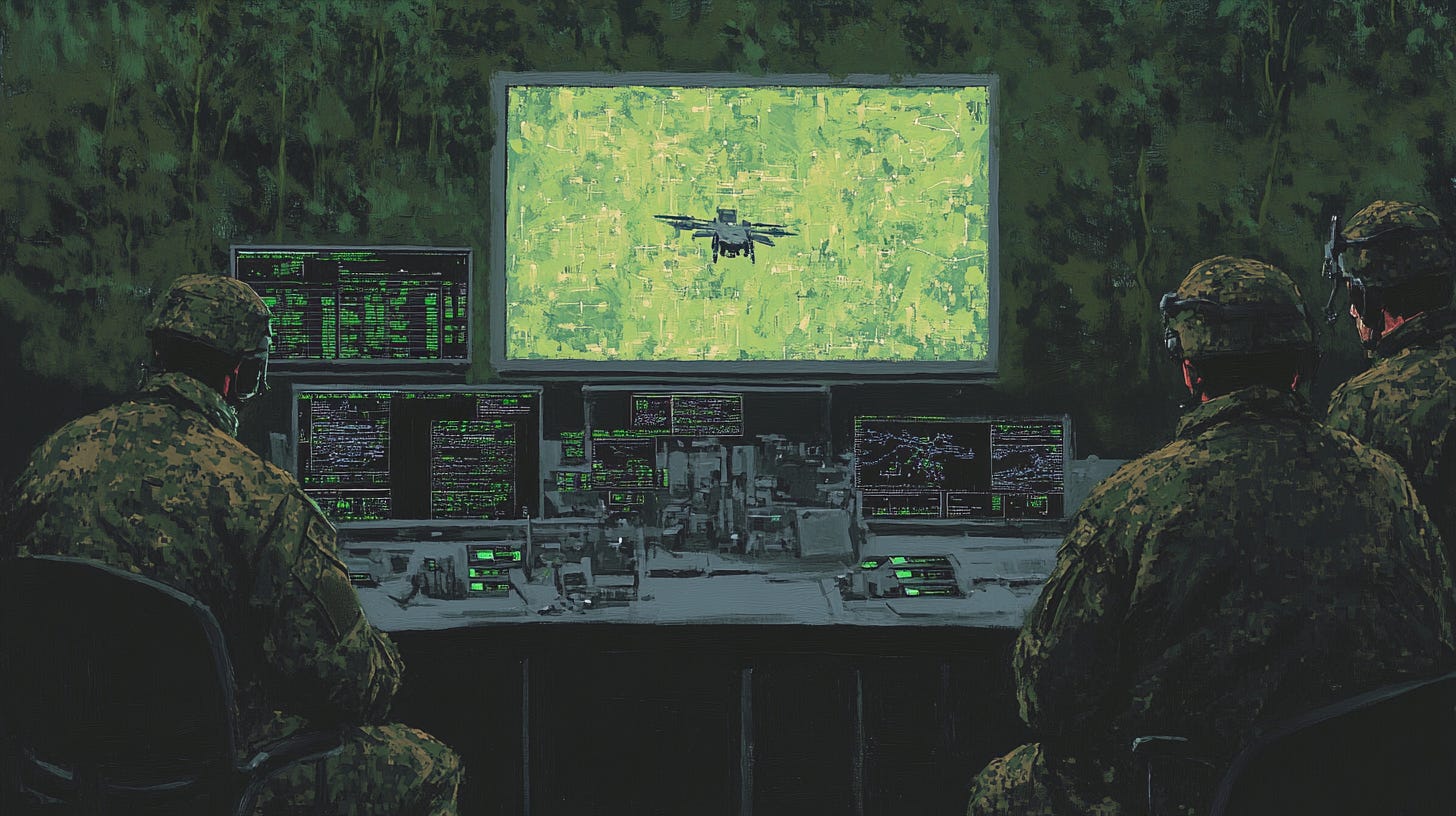
From autonomous weapons systems to planning and strategy, there are countless applications of AI to the world of warfare, and the allure of a competitive edge and reduced casualties are likely to spur on its uptake by militaries around the world. As is often the case, America is likely to lead the way. This week, the Pentagon announced that it was signing a contract with Scale AI, in collaboration with Microsoft and Anduril, to integrate AI systems into military decision-making.
These developments, and more, below.
Federal Government
Pentagon signs contract for AI use in military planning
The Pentagon has signed a contract with Scale AI to integrate advanced AI into military decision-making processes. Referred to as "Thunderforge," the program—built in collaboration with Microsoft and Anduril—integrates AI agents into strategic operations in the U.S. Indo-Pacific and European Commands. It's motivated by the perceived widening gap between the pace of modern warfare and the outdated planning practices prevalent across U.S. military units.
In a recently published assessment on the integration of AI into military mission planning, RAND cautioned against overestimating the technology’s current capabilities. Despite AI's speed advantage—generating updated mission routes in milliseconds rather than the minutes traditional methods require—machine learning approaches less predictable strategies and more variable outcomes, when compared to conventional operations research techniques. This, in addition to steep development costs, and lengthy, resource-intensive training processes.
These findings suggest that, while AI holds promise for narrow domains, its use in complex strategic planning remains premature and unreliable. Previous mistakes, such as the PATRIOT missile system misidentifying friendly aircraft during the Gulf War, demonstrate ways in which less sophisticated systems with more narrow decision-making capabilities can fail.
TSMC to invest an additional $100 billion in American chip manufacturing
Taiwan Semiconductor Manufacturing Company (TSMC) has unveiled a sweeping $100 billion investment to build five advanced chip-manufacturing facilities in the United States. The plan, announced by TSMC CEO C.C. Wei, alongside President Trump, aims to limit America's dependency on semiconductor imports amidst rising geopolitical tensions with China over Taiwan. TSMC's expansion, which includes advanced packaging plants and a significant research hub, aligns with broader U.S. objectives to reestablish domestic semiconductor leadership. Despite investor concerns about higher operational costs in the U.S., the investment claims it will deliver tens of thousands of construction jobs.
The House Energy and Commerce Committee holds a hearing on scaling electricity supply to meet the demand from AI
During a recent hearing for the House Committee on Energy and Commerce Subcommittee on Energy, Congressman Bob Latta (R-OH) claimed that surging power needs—primarily driven by energy-intensive AI models and expanding domestic manufacturing—are putting unprecedented pressure on an electric grid. The coming retirement of over 12 gigawatts of coal capacity this year alone, compounded by policies favoring renewable energy sources, has raised concerns about reliability and affordability. Latta also noted that adversaries, particularly China, are leveraging energy-intensive AI development to project authoritarian influence globally. He stated that “nations like communist China, who does not share our democratic values, are seeking to develop world leading AI models through an authoritarian, military lens to export their command-and-control style of governance across the world.”
H.R.4814 - Consumer Safety Technology Act: Bill that would require regulators to use AI to identify risks to consumer protection passes committee
Reintroduced by Representative Darren Soto (D-FL), the bill would mandate the creation of an AI-driven pilot program within the Consumer Product Safety Commission (CPSC). Intended to enhance the commission's ability to detect hazardous products and monitor online markets for recalled or illicit goods, the pilot program uses AI to proactively identify risks to consumers. Soto argued that regulators must embrace AI to keep pace with increasingly sophisticated criminals.
Press Clips
The Government Knows AGI is Coming (The Ezra Klein Show)
OpenAI’s ex-policy lead criticizes the company for ‘rewriting’ its AI safety history (TechCrunch)
TSMC founder Morris Chang (Acquired)
Democracy Forward requests records on DOGE’s reported AI use (FedScoop)
Taiwan on Trump-Zelenskyy, Getting Nukes, TSMC Deal (ChinaTalk)
Manus: China’s Latest AI Sensation (ChinaTalk)
The political economy of ManusAI (Tyler Cowen)
The Most Dangerous Time in AI Policy (Anton Leicht)
Where inference-time scaling pushes the market for AI companies (Nathan Lambert)
Ban the H20: Competing in the Inference Age (ChinaTalk)
On the US AI Safety Institute, And the role of evaluations in AI governance (Dean Ball)
What the Headlines Miss About the Latest Decision in the Musk vs. OpenAI Lawsuit (Garrison Lovely)
On GPT-4.5 (Zvi Mowshowitz)
What AI can currently do is not the story (Ege Erdil, Epoch AI)
Can Chinese AI chips even run DeepSeek? (Jeffrey Ding)
Generative AI Wargaming Promises to Accelerate Mission Analysis (Johns Hopkins Applied Physics Laboratory)
Christie's AI art auction outpaces expectations, bringing in more than $728,000 (The Art Newspaper)
OpenAI reportedly plans to charge up to $20,000 a month for specialized AI ‘agents’ (TechCrunch)
