


Delivered to your inbox every Monday, Press Clips is a rundown of the previous week’s happenings in politics and tech in America. News, opinion, podcasts, and more, to bring you up to speed for the week ahead.
POLITICS
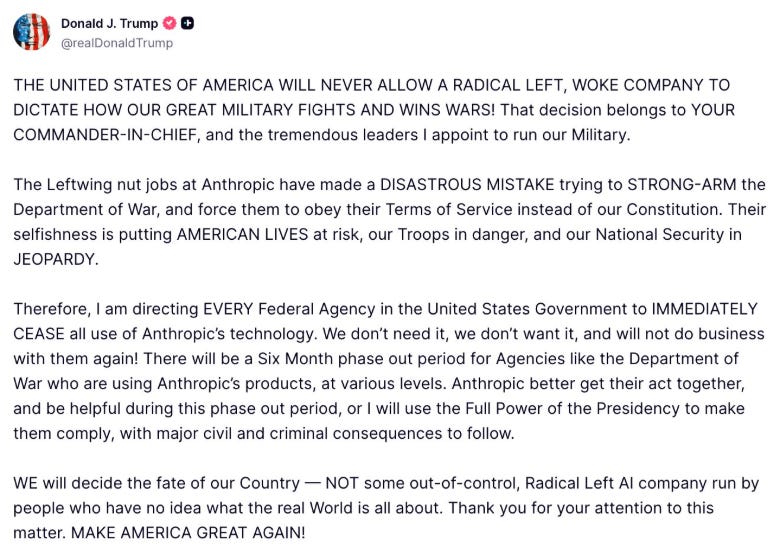
The Trump administration ordered federal agencies to stop using AI systems developed by Anthropic, escalating an ongoing dispute over military use of the company’s models.
The order includes penalties following a phased wind-down period for agencies currently relying on Anthropic’s technology, including the Department of Defense.
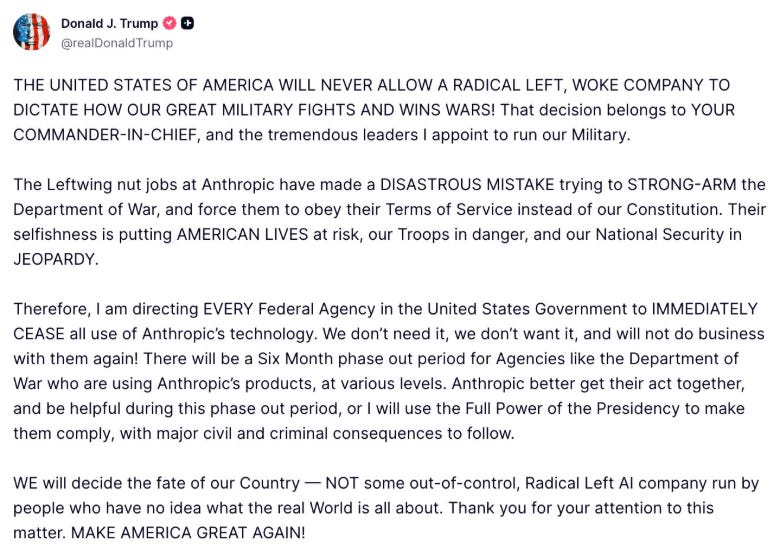
The Department of Defense formally designated Anthropic a “supply chain risk,” a classification typically reserved for foreign adversaries.
Anthropic has said it plans to challenge the designation.
Shortly after the Anthropic decision, OpenAI announced a new agreement with the Pentagon to supply AI systems for classified government networks.
The deal reportedly includes restrictions on mass domestic surveillance and fully autonomous weapons systems.
Over 700 current employees from OpenAI and Google signed a petition opposing Pentagon efforts to pressure AI firms into expanding military use of their models.
The petition cites concerns over surveillance, autonomous weapons, and erosion of company safety commitments.
The Trump administration repealed Biden-era Mercury and Air Toxics Standard.
The EPA has said that this move aims to alleviate utility costs as data center power demand grows.
NIST and CAISI announced a new AI agents standards initiative.

Reps. Brian Babin (R-TX) and Jay Obernolte (R-CA) have requested that the Government Accountability Office produce a report on the current regulations concerning AI policy at the state and federal level.
This request comes in response to ongoing uncertainty and attempts by the White House to preempt or disrupt state AI legislation.
Office of Science and Technology Policy Director Michael Kratsios announced a new “Tech Corps” initiative aimed at delivering “the American AI stack to the world”.
The new initiative was announced at the India Impact AI Summit on Feb. 20.
Kratsios represented the US at the summit, echoing sentiments made by J.D. Vance at last year’s summit in Paris that AI policy discussions should shift emphasis “from safety to opportunity.”
A pro-AI advocacy group aligned with Republican political fundraising efforts claimed it has signed up more than 500,000 supporters nationwide.
The Trump administration has instructed U.S. diplomats to push back against foreign data sovereignty and localisation laws that could restrict how American tech companies handle data abroad.
Sens. Maria Cantwell (D-WA) and Todd Young (R-IN) reintroduced a bipartisan AI innovation bill aimed at strengthening U.S. leadership in artificial intelligence and related technologies.
The White House has engaged with Florida lawmakers to oppose the state’s Artificial Intelligence Bill of Rights, a proposal that would impose new limits on AI use and strengthen protections for minors.
TECH
OpenAI announced a $110 billion funding round — the largest private tech financing in history — valuing the company at $730 billion pre-money.
Amazon led with $50 billion, with Nvidia and SoftBank contributing $30 billion each.
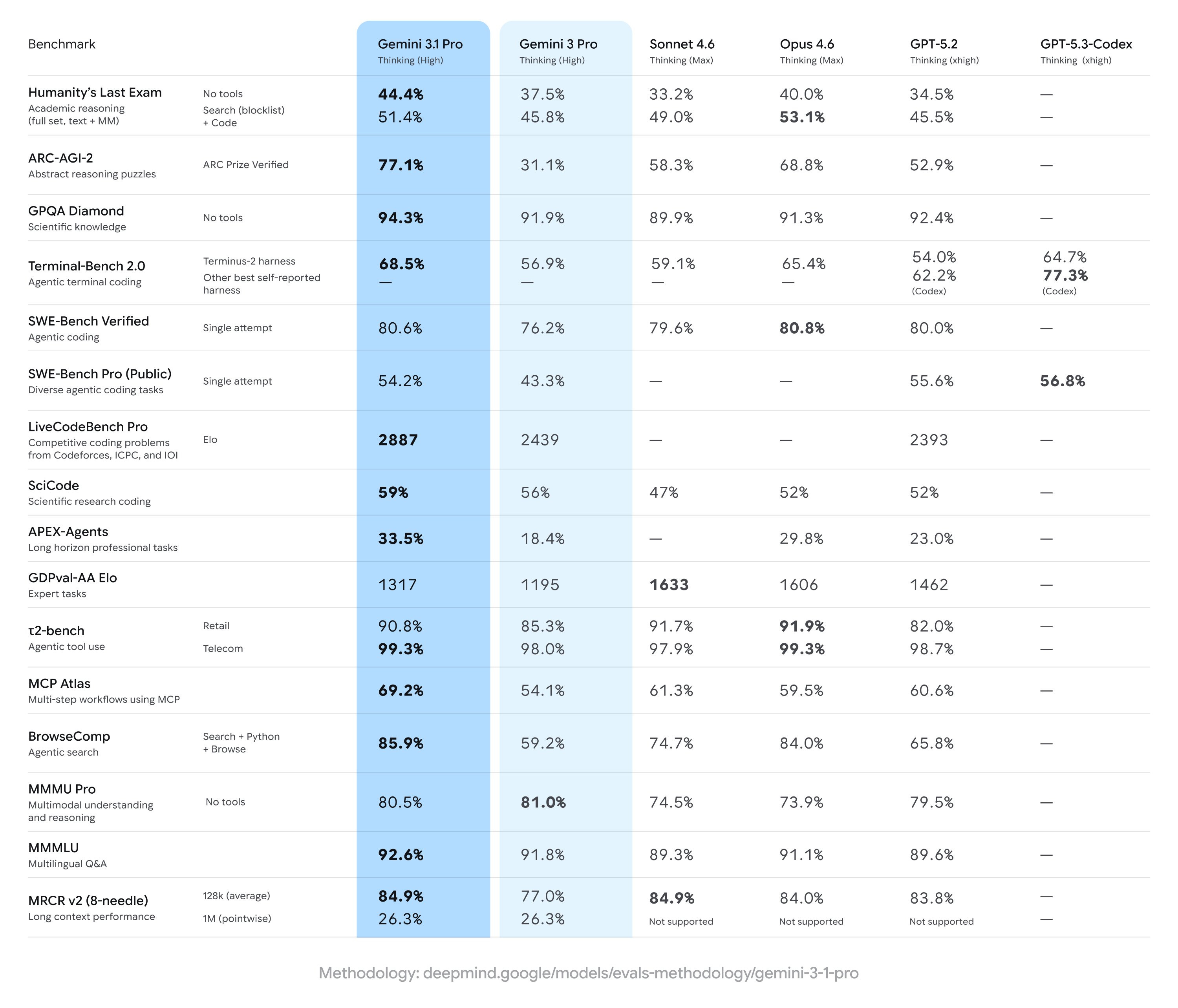
Google’s newly released Gemini 3.1 Pro is boasting record benchmark scores.
Google also added music-generation to the Gemini app, using DeepMind’s Lyria 3 model to deliver the new capability.
OpenAI disclosed that they had flagged the Tumbler Ridge shooter’s chats months prior to the mass shooting.
The company banned Van Rootselaar’s account but did not find that the activity met the “higher threshold required” to report it to law enforcement.
OpenAI has since published a report on the detection and prevention of malicious uses of AI.
In the ongoing Musk v. Altman case, OpenAI filed a motion to exclude expert testimony from AI safety professor Stuart Russell, labeling him a "prominent AI doomer" whose views are "dystopian" and "alarmist."
OpenAI announced "Frontier Alliances" — multi-year partnerships with consulting firms Accenture, BCG, Capgemini, and McKinsey — to help enterprise customers adopt its Frontier AI agent platform.
Anthropic accused Chinese labs DeepSeek, Moonshot AI, and MiniMax of running "industrial-scale campaigns" to extract Claude's capabilities via over 16 million exchanges generated through approximately 24,000 fraudulent accounts.
OpenAI announced that ChatGPT has reached 900 million weekly active users, alongside 50 million paying subscribers.
DISCOURSE
Is AI already killing people by accident? (Gary Marcus) ✍
Sorry skeptics, AI really is changing the programming profession (Understanding AI) ✍
The Pentagon is making a mistake by threatening Anthropic (Understanding AI) ✍
The least understood driver of AI progress (Epoch AI) ✍
How worried should we be about AI biorisk (Transformer) ✍
I’m not convinced the “A.I. backlash” is real (Matthew Yglesias) ✍
How much does distillation really matter for Chinese LLMs? (Interconnects AI) ✍
Full interview: Anthropic CEO responds to Trump order, Pentagon clash 📽
The Moving and the Still - Reflections on Delhi (Dean Ball - Hyperdimensional) ✍
The case for wasteful agents (The AI Frontier) ✍
The Race to Build God: AI’s Existential Gamble (Your Undivided Attention) 🔉
Why Teaching AI Right from Wrong Could Get Everybody Killed - Max Harms (80,000 Hours Podcast) 🔉
The AI Skeptics (The Last Invention) 🔉
Why we need a moratorium on superintelligence research (Transformer) ✍
✨⚕️ Must AI cure cancer? (Faster, Please!) ✍
🔮 Where the human ends and AI begins (Exponential View) ✍🔉📽